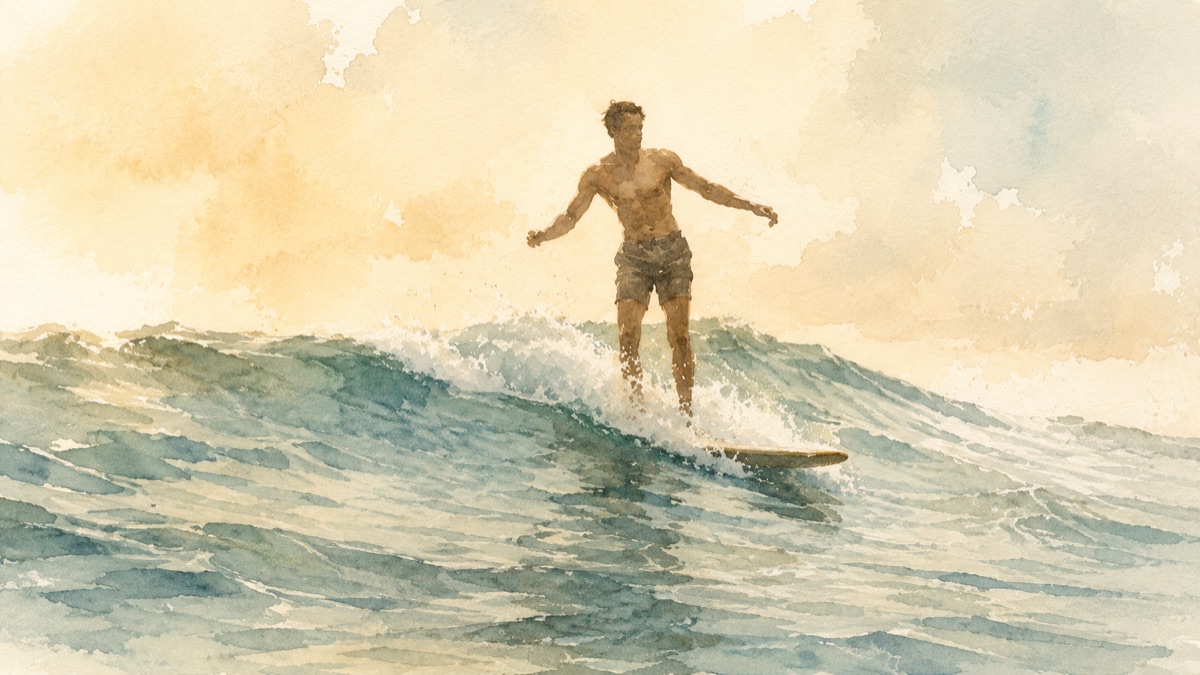
The History of Surfing: From Finless Planks to Solar-Powered Wave Pools
The full story of surfing — from its sacred Polynesian roots and near-death in the 1800s, through Duke Kahanamoku, the shortboard revolution and pro tour, to Olympic gold and solar wave pools.
In this article
- Sacred Beginnings: Surfing in Ancient Polynesia
- The Near-Death of Surfing
- The Waikiki Revival and Duke Kahanamoku
- Foam, Fibreglass and the Modern Surfboard
- Gidget, the Beach Boys and the Boom
- The Shortboard Revolution
- The Birth of Professional Surfing
- The Thruster and the Performance Era
- The Slater Era and the New School
- Perfect Waves, Olympic Gold and Solar Power
In this article, you'll learn
- How surfing began in Polynesia and became sacred in ancient Hawaii
- Why surfing nearly died out in the 1800s — and who brought it back
- How Duke Kahanamoku carried surfing to California and Australia
- The board breakthroughs: the fin, foam, and the shortboard revolution
- How surfing went pro, global, Olympic, and into solar-powered wave pools
I have been fascinated by surf history since the mid-1980s. It started with my stepfather's collection of Surfer and Surfing magazines. Living in South Africa, those magazines came a very long way to reach me, and they told stories of places so unfathomable they rewrote my sense of what was possible in the world: Huntington Beach, the North Shore of Hawaii, some far-off land called Australia, and a thousand secret spots in between.
I started surfing around the same time, and I fell headlong into the culture — the books, the surf movies, the world tour. Back then, if you wanted to know what was happening in the wider world of surfing, you waited for the next copy of Zig-Zag, South Africa's premier surf mag. Eventually I started having my own photos published in Zig-Zag, along with an article or two. And decades later, in 2003, I launched this very site — which, in its own small way, is now a part of the history of surfing too.
This piece is here to help you understand the key milestones in the evolution of a pastime that has, almost certainly, been happening since prehistoric times.
Picture it. Some tribe arrives at an ocean for the first time. Someone picks up a log and tries to float out into the water on it. A wave comes. Tribesman tumbles. Eight hundred years later, a plank of wood — split roughly in half, one face almost flat — washes up on the same shore. A distant ancestor of our original protagonist paddles out on it, catches a fish, paddles back in, and one day notices that if he paddles at the same speed as a passing wave, the water lifts him up and carries him along.
We'll never know that first surfer's name. But from there — from finless planks to wave pools running on solar energy — we can trace the story. So let's go to recorded history.
Sacred Beginnings: Surfing in Ancient Polynesia
Surfing was born in Polynesia and reached its highest form in Hawaii, where it was known as he‘e nalu — "wave sliding." Far from a beach pastime, it was stitched into the fabric of society. There were prayers for good surf, rituals for choosing and shaping a board, and even chants to coax the ocean to life.
It was also a language of status. Chiefs rode the olo — enormous boards, some longer than five metres, shaped from prized koa or wiliwili wood. Commoners rode the shorter, thinner alaia. The best breaks could be reserved for royalty, and a great surfer commanded genuine respect. Wave-riding was competition, courtship, spirituality and sport, all at once.
The first outsider to write it down was Lieutenant James King, who took over Captain Cook's journals after Cook was killed in Hawaii. In 1779, at Kealakekua Bay, King described Hawaiians riding the surf with an admiration that still reads clearly across the centuries.
The Near-Death of Surfing
Then came the near-extinction. Through the 1800s, Western contact devastated Hawaii. Introduced diseases collapsed the population, and Calvinist missionaries — who saw a near-naked, joyful, gambling-adjacent pursuit as everything they'd come to stamp out — discouraged surfing along with much of traditional Hawaiian culture.
By the end of the nineteenth century, the sport that had once defined an entire people had dwindled to a handful of surfers at Waikiki. It came remarkably close to disappearing altogether.
The Waikiki Revival and Duke Kahanamoku
Surfing's comeback began in the early 1900s, and it had a cast of characters.
Writer Jack London visited Waikiki in 1907 and published A Royal Sport: Surfing at Waikiki, romanticising the "brown Mercury" George Freeth and setting off a wave of curiosity. That same era, Freeth was brought to California to give surfing demonstrations, billed as "the man who could walk on water." In 1908, Alexander Hume Ford founded the Outrigger Canoe Club at Waikiki specifically to keep wave-riding alive.
But the towering figure is Duke Kahanamoku. A native Hawaiian and Olympic swimming gold medallist, Duke became surfing's greatest ambassador. He demonstrated the sport in California, and in 1914 he travelled to Australia and surfed at Sydney's Freshwater Beach on a board he shaped himself from local timber — a moment now considered the birth of Australian surfing. Wherever Duke went, surfing followed. He is, rightly, remembered as the father of the modern sport.
Around the same time, Tom Blake began dragging board design into the modern age. In the 1920s and '30s he built lighter hollow boards, pioneered the shift away from heavy solid planks, and — crucially — around 1935 became the first person to fix a fin to the bottom of a surfboard. That single skeg unlocked control, and everything that came after depended on it.
Foam, Fibreglass and the Modern Surfboard
For most of surfing's history, boards were heavy slabs of solid wood. That changed fast after the Second World War, when a wave of Californian shapers — Bob Simmons, Joe Quigg, Matt Kivlin — started experimenting with balsa, fibreglass and resin to build the lighter, livelier "Malibu chip" boards of the late 1940s.
The real democratisation came from Hobie Alter and Gordon "Grubby" Clark. By the late 1950s they had figured out how to mass-produce polyurethane foam blanks. Clark Foam boards were lighter, cheaper and far easier to make than anything before — and suddenly a surfboard was something an ordinary teenager could actually own.
Gidget, the Beach Boys and the Boom
Then surfing collided with American pop culture and exploded.
In 1957, a screenwriter named Frederick Kohner turned his teenage daughter's Malibu summer into a novel called Gidget. The 1959 film adaptation put surfing in front of millions. The Beach Boys and Dick Dale gave it a soundtrack; Bruce Brown's 1966 masterpiece The Endless Summer gave it a mythology — two surfers chasing summer around the globe in search of the perfect wave.
This was the golden age of the longboard: Malibu at its peak, Miki Dora dancing across the nose, and a whole generation deciding that this — sun, saltwater, freedom — was the only life worth living.
The Shortboard Revolution
Between about 1967 and 1969, surfing tore itself up and started again.
In just a couple of years, board lengths plummeted from around 9'6" to under seven feet. Australians like Bob McTavish and reigning world champion Nat Young, Californian shapers like Dick Brewer, and the radical fin ideas of George Greenough converged on one conclusion: shorter boards could go where longboards couldn't — up into the steep part of the wave, turning hard, surfing vertically. It was the biggest single leap in performance the sport had ever seen, and modern surfing was born in it.
The Birth of Professional Surfing
The 1970s took that new performance and built a sport around it. Professional surfing was formalised when the International Professional Surfers (IPS) tour came together in 1976. Gerry Lopez made stylish, fearless tube-riding at Pipeline look like meditation. Mark Richards' twin-fin pushed the boundaries of speed.
The gear kept catching up, too. The surf leash arrived in the early '70s (thank Jack O'Neill's son, Pat, for the black eyes that followed). And the wetsuit — which Jack O'Neill had been developing in the cold water of Northern California since around 1952 — opened up coastlines that had been simply too cold to surf.
The Thruster and the Performance Era
In 1980, Australian Simon Anderson bolted a third fin to the tail of his board and changed everything again. His Thruster — three fins of equal size — offered drive, control and release that twin-fins and single-fins couldn't match. Anderson proved it by winning major events in powerful surf, and within a couple of years the tri-fin became the global standard it remains today.
The 1980s pro tour, run by the newly formed ASP from 1983, gave us the stylish brilliance of Tom Curren and the raw power of Mark Occhilupo — and turned surfing into a genuine spectator sport.
The Slater Era and the New School
Then came Kelly Slater. From his first world title in 1992, Slater and the "new school" generation dragged surfing skywards — literally — as aerials moved from novelty to necessity and boards shrank to slivers.
At the other extreme, big-wave surfing was being reinvented. Tow-in surfing, pioneered by Laird Hamilton and friends in the 1990s, used jet-skis to fling riders onto waves too big and too fast to paddle into — opening up monsters like Jaws (Pe‘ahi) and, later, the terrifying slab of Teahupo‘o. The frontier of what was rideable kept moving, and it hasn't stopped.
Perfect Waves, Olympic Gold and Solar Power
Which brings us to now — an era that would have looked like pure science fiction to that kid rifling through surf mags in South Africa.
In 2015, Kelly Slater's Surf Ranch unveiled a machine-made wave so long and so perfect it broke the internet, kicking off a global wave-pool boom that has since spread from the Californian desert to the outskirts of Melbourne and beyond. Surfing finally made the Olympics, debuting at Tokyo 2020 and returning at Paris 2024 — held, remarkably, in the heaving reef of Teahupo‘o. Women's surfing won equal prize money on the world tour in 2019. Foils let riders fly above the water entirely.
And, fittingly for a sport that lives and dies by the health of the ocean, sustainability has moved to the centre of the story — with a new generation of wave pools now designed to run on solar energy.
From an unnamed ancestor paddling a split log, to a Hawaiian king on a five-metre olo, to Duke on Sydney sand, to a perfect wave pumping through a solar-powered pool in the desert — surfing has never stopped reinventing itself. And every one of us who paddles out is, whether we think about it or not, part of the next chapter.
Frequently asked questions
- Where did surfing originate?
- Surfing originated in Polynesia and reached its fullest expression in ancient Hawaii, where wave-riding — he‘e nalu — was woven into spirituality, status and daily life. The first written account came from Lieutenant James King, who documented Hawaiian surfing in 1779 while completing Captain Cook's journals.
- Who is considered the father of modern surfing?
- Duke Kahanamoku, the Hawaiian Olympic swimming champion, is widely regarded as the father of modern surfing. In the early 1900s he demonstrated the sport in California and, famously, in Australia in 1914, spreading surfing far beyond Hawaii.
- When did the shortboard revolution happen?
- The shortboard revolution took place between roughly 1967 and 1969, when board lengths dropped from around 9'6" to under 7' in just a couple of years, transforming surfing from graceful trimming into vertical, high-performance wave-riding.
- When did surfing become an Olympic sport?
- Surfing made its Olympic debut at the Tokyo 2020 Games (held in 2021) and returned at Paris 2024, contested in the heavy reef break of Teahupo‘o in Tahiti.